Every post in this series so far has assumed the well is going according to plan. This one covers what happens when it doesn’t — specifically, when the drill string gets stuck downhole, and the tool built specifically to deal with it: drilling jars.
Stuck pipe isn’t a rare edge case in directional drilling — it’s one of the most common and expensive problems in the industry, and directional wells are more exposed to it than straight holes because of the extra wellbore geometry (curves, doglegs, angle changes) involved. Understanding why pipe gets stuck, and how jars actually free it, is essential knowledge even if you never have to use it.
Two Very Different Ways Pipe Gets Stuck
It helps to split sticking mechanisms into two broad families, because the fix for one can make the other worse.
Differential Sticking
This happens when part of the drill string — usually the drill collars — gets pressed into the filter cake on the wall of the wellbore, and the pressure difference between the wellbore fluid and the formation pins it there. It requires two specific conditions: a permeable formation and a pressure differential across a filter cake. Once stuck this way, the pipe genuinely can’t move axially — it’s being held by hydraulic force, not by a physical obstruction.
Mechanical / Wellbore Geometry Sticking
This is the broader category, and it covers a handful of distinct problems:
- Key seating — happens when tool joints repeatedly wear a narrow groove into the side of the hole in a doglegged section. The groove is fine for the tool joint to pass through, but too narrow for the larger drill collars or stabilizers behind it — so the string physically can’t be pulled back through.
- Undergauge hole — the hole shrinks below bit size, often from formation swelling or wear, and larger BHA components simply can’t pass.
- Ledges and doglegs — abrupt changes in hole angle create physical shoulders that catch the string.
- Junk — debris left in the hole from a previous run.
- Cement-related sticking — cement blocks or “green” (insufficiently set) cement that hasn’t cured properly.
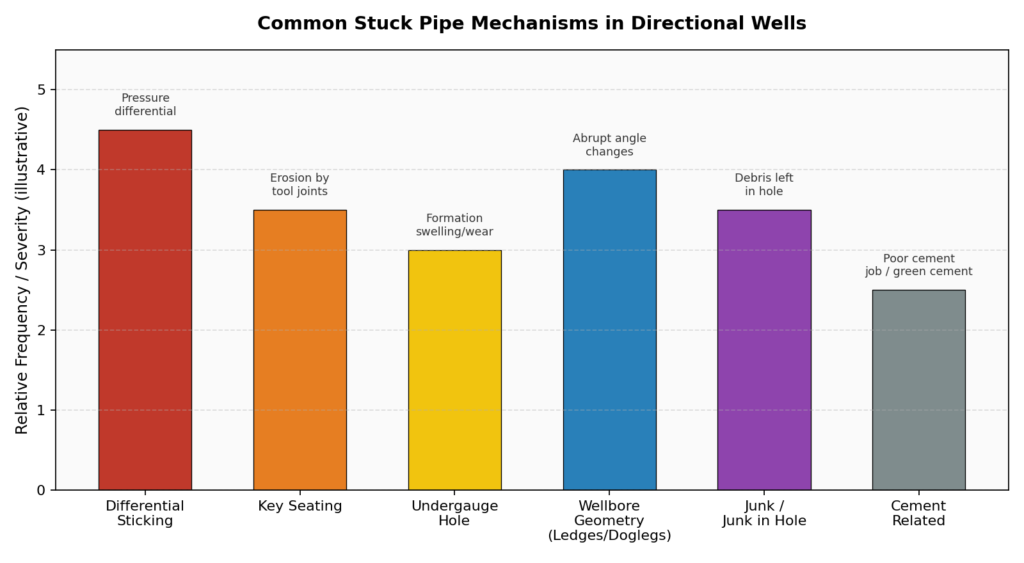
The reason this distinction matters operationally: differential sticking is generally addressed by reducing the pressure differential (or working the pipe to break the seal), while mechanical sticking is a physical obstruction problem — and that’s exactly the kind of problem drilling jars exist to solve.
What a Drilling Jar Actually Does
A drilling jar is essentially a mechanism for storing potential energy and then releasing it all at once as a sharp, violent mechanical impact — a hammer inside the tool strikes an anvil, and that impact travels down (or up) the string to try to break the stuck section free. There are three main designs, and they store that energy differently.
Mechanical Jars
These use a weight-triggered mechanical release. The jar fires once a preset trigger weight is reached, and because that weight can be preset for either direction, mechanical jars can jar both up and down.
Hydraulic Jars
These rely on hydraulic oil, compressed and forced through a small metering opening. Once the mandrel has traveled its prescribed distance — not a specific weight — the oil bypasses the opening and the jar fires. The force of the resulting blow depends on how much weight was applied while cocking the jar, and repeated heavy use can heat the hydraulic oil, reducing its viscosity and weakening the strike over time.
Hydro-Mechanical Jars
A hybrid design — typically hydraulic in the up direction and mechanical in the down direction, combining the strengths of both trigger types in one tool.
The Cocking and Tripping Weight Math
Before a mechanical jar can even be considered for use, the crew needs to know exactly how much weight is required to cock it (build up the potential energy) and how much is required to actually trip it (fire it), in both the up and down direction. The formulas pull together a few key inputs:
- WtDn / WtUp — the slack-off or pull weight measured just before the pipe got stuck
- WtBHAbelowJar — the weight of everything below the jars, adjusted for buoyancy and hole angle
- POF (Pump Open Force) — a correction for any pressure differential acting across the jars, supplied by the manufacturer
For example, cocking weight in the up direction is calculated as:
Cocking Weight (Up) = Slack-off Weight − Pump Open Force − Weight of BHA below jars − 2,200 kg
Tripping weight follows a similar structure, but incorporates the jar’s own preset firing force instead of the fixed 2,200 kg constant. Getting these numbers right matters — apply too little force and the jars never fire; misjudge the wrong direction and you risk adding more stress to an already-stuck string.
Where Jars Actually Go in the BHA
Every drill string has a point called the neutral point — the depth in the string where it transitions from being in tension (suspended, above) to being in compression (pushed down by weight on bit, below). Jar placement relative to that point is one of the more precise rules in BHA design:
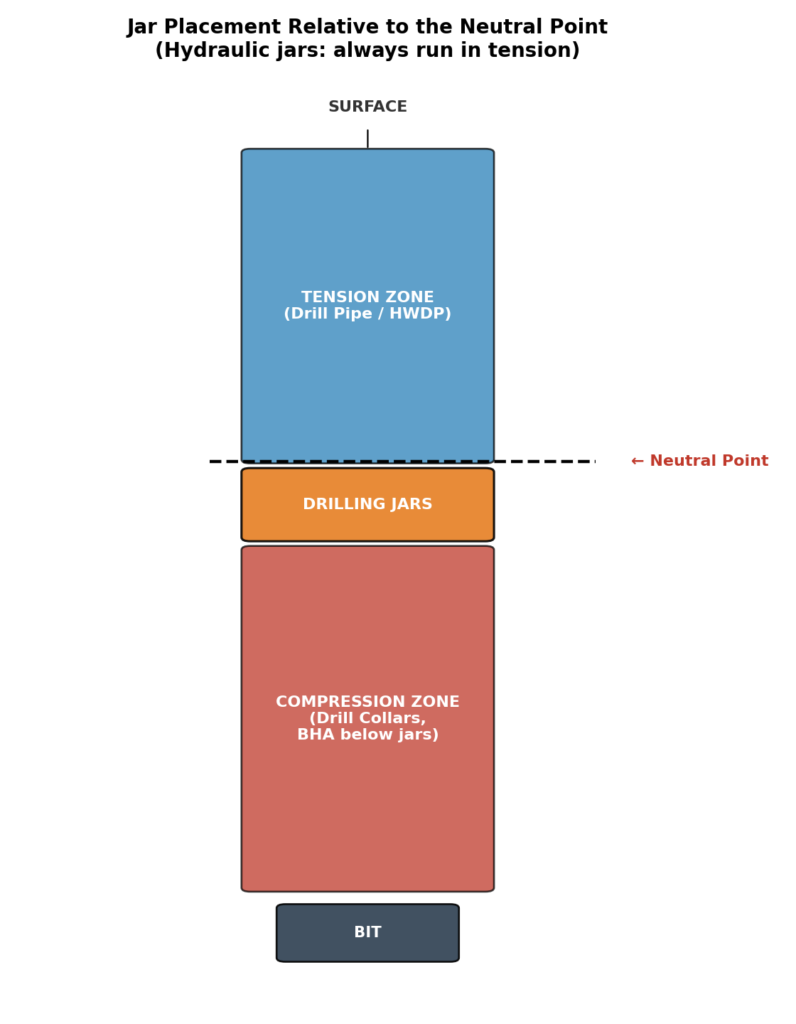
A few rules that come directly out of this logic:
- Never place a jar exactly at the neutral point — that’s the one place in the string where axial forces are the least predictable.
- Hydraulic jars should always be run in tension. If they’re placed in compression, they’ll cock every single time the string tags bottom, which isn’t the intended trigger condition and wears the tool out fast.
- Mechanical jars are more flexible — they can be run in either tension or compression, as long as the expected forces in that position don’t exceed the tool’s rated tripping values.
- In vertical wells, at least two drill collars are typically placed below the jars to provide enough mass for a solid down-jar strike, and stabilizers are generally avoided above the jars.
- In horizontal wells, jarring downward gets progressively harder simply because gravity isn’t helping deliver weight to the jars anymore — so for up-jarring, the jars are usually placed just above the neutral point instead, since BHA weight below them plays no role in cocking an upward strike.
Because inclination changes the tension/compression balance throughout the string, cocking and tripping weights should be recalculated every 30 degrees of inclination change — a static calculation from the vertical section of the well won’t hold once the wellbore has curved significantly.
Why This Matters Even If You Never Get Stuck
Most wells never need the jars fired in anger. But every directional BHA still gets designed with sticking risk in mind — placement, stabilizer spacing, and dogleg limits are all partly driven by the goal of not needing the jars at all. Understanding the mechanics of stuck pipe is really understanding the failure mode the rest of the BHA design is quietly trying to avoid.
Coming Up Next
We’ve now covered planning, surveying, math, motors, bits, and what happens when the string gets stuck. The next post zooms out to the planning side again — anti-collision and advanced well planning — how operators keep multiple wellbores from crossing paths on a busy platform, and what an ellipsoid of uncertainty actually represents.
This is post 6 in an ongoing series on the fundamentals of directional drilling. Catch up on well profiles (post 1), survey tools (post 2), BUR/dogleg severity math (post 3), steerable motors (post 4), and bit selection (post 5) if you’re just joining in.