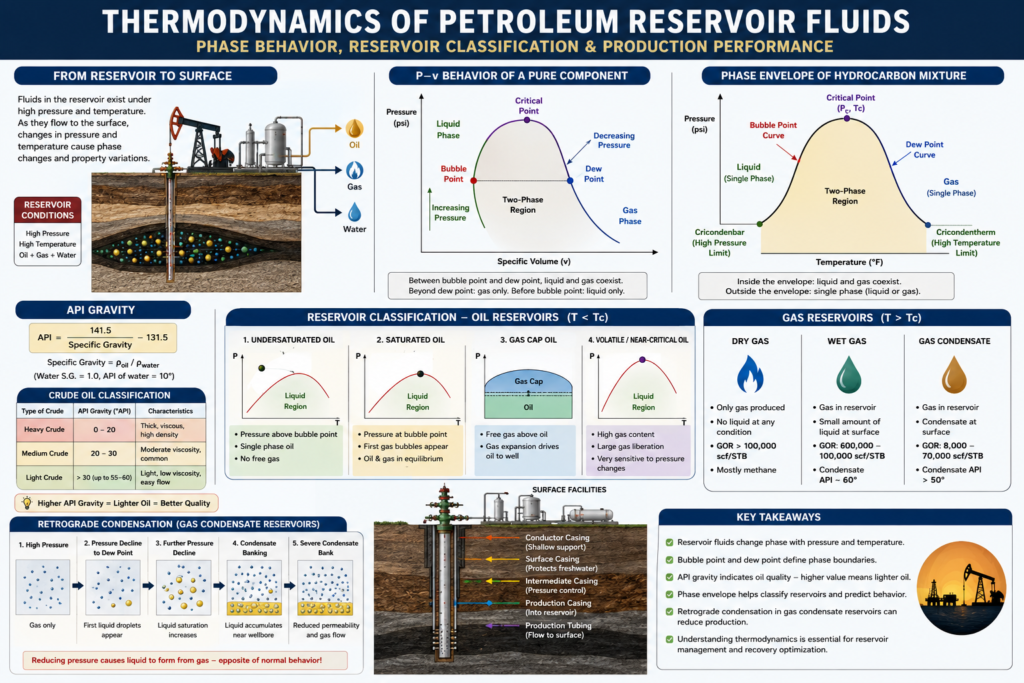
Thermodynamics of Petroleum Reservoir Fluids: Understanding Phase Behavior, Reservoir Classification, and Production Performance
Introduction
Petroleum reservoirs are not simply underground storage tanks filled with oil or gas. They are complex geological systems where hydrocarbons exist under high pressure and temperature conditions inside porous reservoir rocks. As these fluids travel from deep underground formations to the surface, they experience significant changes in pressure and temperature, causing changes in their physical state and behavior.
Understanding the thermodynamic behavior of reservoir fluids is one of the most important aspects of petroleum reservoir engineering. It helps engineers predict production performance, design surface facilities, estimate reserves, and optimize hydrocarbon recovery.
This article explores the thermodynamics of hydrocarbon fluids, phase behavior, phase diagrams, API gravity, and the classification of oil and gas reservoirs based on pressure-temperature relationships.
Why Reservoir Fluid Thermodynamics Matters
Oil, gas, and water are stored together within reservoir rocks beneath the Earth’s surface. During production, these fluids move through the reservoir and wellbore before reaching separators and processing facilities.
As pressure decreases and temperature changes:
- Gas may come out of solution from crude oil.
- Liquid hydrocarbons may condense from natural gas.
- Fluid properties such as density, viscosity, and volume change.
- Production behavior can vary dramatically.
Understanding these phase changes allows engineers to:
- Predict reservoir performance.
- Design production equipment.
- Estimate recoverable reserves.
- Select suitable recovery methods.
- Prevent production problems.
Understanding API Gravity
API Gravity is one of the most widely used measures for classifying crude oil quality.
API Gravity Formula
API Gravity is calculated as:
API = (141.5 / Specific Gravity) − 131.5
Where:
Specific Gravity = Density of Oil / Density of Water
Since water has a specific gravity of 1.0, its API gravity is 10° API.
Classification of Crude Oil by API Gravity
Heavy Crude Oil
- API Gravity: 0°–20°
- Thick and viscous
- Difficult to produce and refine
Medium Crude Oil
- API Gravity: 20°–30°
- Moderate viscosity
- Common commercial crude
Light Crude Oil
- API Gravity: Above 30°
- Flows easily
- Higher market value
- Easier refining process
In general:
Higher API Gravity = Lighter Oil = Better Quality
Fundamentals of Hydrocarbon Phase Behavior
The behavior of petroleum fluids is described using Pressure-Volume-Temperature (PVT) relationships.
Phase behavior explains how hydrocarbons change between:
- Liquid phase
- Gas phase
- Liquid-Gas mixture
under varying pressure and temperature conditions.
Bubble Point and Dew Point
Two important concepts in reservoir thermodynamics are:
Bubble Point
The pressure at which the first bubble of gas appears from a liquid.
When reservoir pressure falls below the bubble point:
- Dissolved gas begins leaving the oil.
- Oil volume decreases.
- Gas production increases.
Dew Point
The pressure at which the first liquid droplet forms from a gas.
When pressure falls below the dew point:
- Condensation begins.
- Liquid hydrocarbons form from gas.
These points define the boundaries of phase transitions.
Critical Temperature and Critical Pressure
Every hydrocarbon system has a critical point.
Critical Temperature (Tc)
The highest temperature at which liquid and gas can coexist.
Above this temperature:
- No amount of pressure can liquefy the gas.
Critical Pressure (Pc)
The minimum pressure required to liquefy a gas at its critical temperature.
At the critical point:
- Liquid and gas properties become identical.
- Density differences disappear.
Phase Envelope of Hydrocarbon Mixtures
Unlike pure substances, petroleum fluids contain many hydrocarbon components.
As a result:
- Bubble point becomes a curve.
- Dew point becomes a curve.
- Together they form a Phase Envelope.
Inside the envelope:
- Liquid and gas coexist.
Outside the envelope:
- Single-phase fluid exists.
The shape of the envelope depends on fluid composition.
Cricondentherm and Cricondenbar
For multi-component hydrocarbon systems, two additional terms are important.
Cricondentherm
The highest temperature at which liquid and gas can coexist.
Cricondenbar
The highest pressure at which liquid and gas can coexist.
These points define the upper limits of two-phase behavior.
Classification of Petroleum Reservoirs
Reservoirs can be classified according to their location on the phase diagram.
Oil Reservoirs
Oil reservoirs exist when reservoir temperature is below critical temperature.
1. Undersaturated Oil Reservoir
Characteristics:
- Reservoir pressure above bubble point pressure.
- Oil exists as a single liquid phase.
- No free gas present.
Advantages:
- Stable production.
- High oil recovery potential.
2. Saturated Oil Reservoir
Characteristics:
- Reservoir pressure equals bubble point pressure.
- First gas bubbles begin to form.
Production behavior becomes more sensitive to pressure decline.
3. Gas Cap Reservoir
Characteristics:
- Free gas exists above oil.
- Gas expansion helps drive oil toward the well.
Benefits:
- Natural pressure support.
- Improved oil recovery.
Types of Crude Oil Reservoirs
Black Oil Reservoir
Characteristics:
- GOR: 200–700 scf/STB
- API Gravity: 15–40°
Features:
- Most common oil reservoir.
- Produces relatively little gas.
Low-Shrinkage Oil Reservoir
Characteristics:
- Low gas liberation.
- Small volume reduction during production.
Volatile Oil Reservoir
Characteristics:
- High gas content.
- Significant gas release during pressure depletion.
Produces:
- More gas than conventional black oil.
Near-Critical Oil Reservoir
Characteristics:
- Reservoir conditions close to critical point.
- Extremely sensitive to pressure changes.
Even small pressure drops can cause large phase changes.
Gas Reservoir Classification
Gas reservoirs occur when reservoir temperature exceeds critical temperature.
Dry Gas Reservoir
Characteristics:
- Produces only gas.
- No liquid hydrocarbons form.
Typical GOR:
- Greater than 100,000 scf/STB
Composition:
- Mostly methane.
Wet Gas Reservoir
Characteristics:
- Gas exists in the reservoir.
- Small liquid volume condenses at surface conditions.
Typical GOR:
- 60,000–100,000 scf/STB
Condensate API:
- Around 60° API
Gas Condensate Reservoir
Characteristics:
- Reservoir temperature between critical temperature and cricondentherm.
Produces:
- Gas in the reservoir.
- Condensate liquids at surface conditions.
Typical GOR:
- 8,000–70,000 scf/STB
Condensate API:
- Above 50° API
Retrograde Condensation: A Unique Hydrocarbon Behavior
One of the most fascinating petroleum engineering phenomena is Retrograde Condensation.
Normally:
- Increasing pressure converts gas to liquid.
- Decreasing pressure converts liquid to gas.
However, in gas-condensate reservoirs:
- Reducing pressure causes liquid to form from gas.
This reverse behavior is called Retrograde Condensation.
How Retrograde Condensation Occurs
As reservoir pressure declines:
- Gas reaches dew point.
- Liquid condensate begins forming.
- Condensate saturation increases.
- Liquid accumulates near the wellbore.
This creates a Condensate Bank around the well.
Problems Caused by Condensate Banking
Condensate accumulation can:
- Reduce gas permeability.
- Restrict gas flow.
- Lower production rates.
- Cause significant recovery losses.
Managing Condensate Reservoirs
Common strategies include:
Pressure Maintenance
Maintaining reservoir pressure above dew point.
Gas Recycling
Produced gas is re-injected into the reservoir to:
- Preserve pressure.
- Reduce condensate dropout.
- Improve liquid recovery.
Gas-Oil Ratio (GOR)
GOR is one of the most important reservoir classification parameters.
Oil Wells
GOR < 5,000 scf/STB
Condensate Wells
GOR between 5,000 and 100,000 scf/STB
Gas Wells
GOR > 100,000 scf/STB
GOR provides valuable insight into reservoir fluid characteristics and production behavior.
Importance of Phase Diagrams in Reservoir Engineering
Phase diagrams help engineers:
- Classify reservoirs.
- Predict fluid behavior.
- Design separators.
- Optimize production systems.
- Estimate reserves.
- Plan enhanced recovery projects.
Without phase behavior analysis, efficient reservoir management would be impossible.
Conclusion
The thermodynamics of petroleum reservoir fluids forms the foundation of reservoir engineering. By understanding pressure-temperature relationships, phase envelopes, bubble points, dew points, critical properties, and retrograde behavior, engineers can accurately predict how hydrocarbons behave from reservoir to surface.
Whether dealing with black oil reservoirs, volatile oils, wet gas systems, or gas condensate reservoirs, phase behavior analysis remains essential for maximizing production, improving recovery efficiency, and ensuring economic petroleum operations. Understanding these concepts allows petroleum engineers to transform complex underground hydrocarbon systems into profitable and sustainable energy resources.