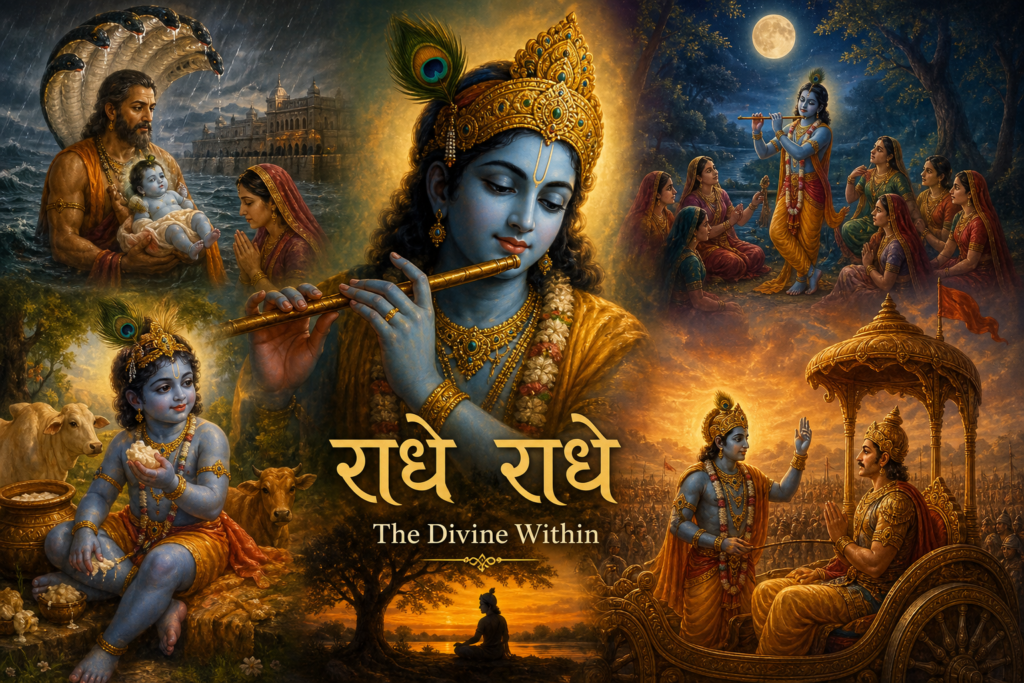
Among the countless stories that shape the spiritual landscape of India, few shine brighter than the life of Krishna — the cosmic strategist, the divine lover, the mischievous child, and the ever-present guide who sustains the rhythm of life itself.
His story, preserved in the Bhagavata Purana, unfolds as a series of mystical events that merge human emotion with divine purpose. Every era finds new meaning in Krishna’s stories; every seeker finds a reflection of the self.
The Birth That Defied Darkness
Krishna’s birth, celebrated as Janmashtami, isn’t just a night festival — it’s a moment when light itself descends into darkness. Born in the prison cell of Mathura to Devaki and Vasudeva under the tyranny of King Kamsa, his arrival marks the assurance that even the darkest night can give birth to new dawns.
When Vasudeva carried the newborn across the flooding Yamuna to Gokul, the universe shifted — the river parted, the serpent Adishesha shielded the child, and the cosmic order began to reset.
Gokul and Vrindavan: The Realm of Play and Love
In the cowherd village of Vrindavan, Krishna’s divinity took the form of everyday miracles — lifting mountains, slaying demons, and filling hearts with music. His flute was more than melody; it was the call of the soul.
The gopis and gopas who danced around him were not mere villagers — they symbolized the soul’s longing for oneness. When Krishna played his flute in the moonlit forest and the gopis abandoned everything to join him, it wasn’t desire but devotion — the sacred dance between the finite and the infinite, the seeker and the sought.
The Divine Strategist of the Mahabharata
Years later, Krishna would leave behind the serenity of Vrindavan for the moral battlefield of Kurukshetra. As the charioteer of Arjuna, he revealed the timeless wisdom of the Bhagavad Gita, showing that duty and detachment are not opposites but allies in the path of Dharma.
Krishna was not merely a mediator; he was the conductor of destiny. He used the war not for conquest but for cleansing — to restore cosmic balance by removing those who abused power.
His role in the Mahabharata stands as a reminder that God does not avoid conflict — He transforms it into awakening.
The Final Years: Silence After the Song
After the great war, Krishna withdrew to Dwarka, watching the slow unraveling of his own clan. As foretold, he left the world as quietly as he entered it — a single arrow from a hunter marking the end of his earthly Leela.
Yet, his death was no tragedy. It was Moksha — the return to Goloka, the eternal realm beyond creation, where love is everlasting and form dissolves into essence.
Radha: The Heart That Completes the Divine
No story of Krishna is complete without Radha, not as a consort but as the soul of devotion itself. Radha is love stripped of possession — the bridge that leads every heart to Krishna. That is why even today, the chant of “Radhe Radhe” echoes through Vrindavan’s streets, reminding seekers that the path to the Divine always begins with love.
The Eternal Relevance of Krishna
Krishna’s life can’t be contained in one form. To a philosopher, he is wisdom. To a child, he is play. To a lover, he is the heartbeat. To a warrior, he is focus. Every phase of his life mirrors a phase of ours.
He teaches that spirituality isn’t about escaping the world — it’s about seeing the world as a divine play.
In essence, Krishna’s journey — from the prison of Mathura to the field of Kurukshetra — is our story too: the soul’s movement from bondage toward liberation, from confusion toward clarity, from devotion toward union.
So the next time you whisper Radhe Radhe or chant Hare Krishna, remember: you are not calling out to a distant god, but awakening the divine within yourself.