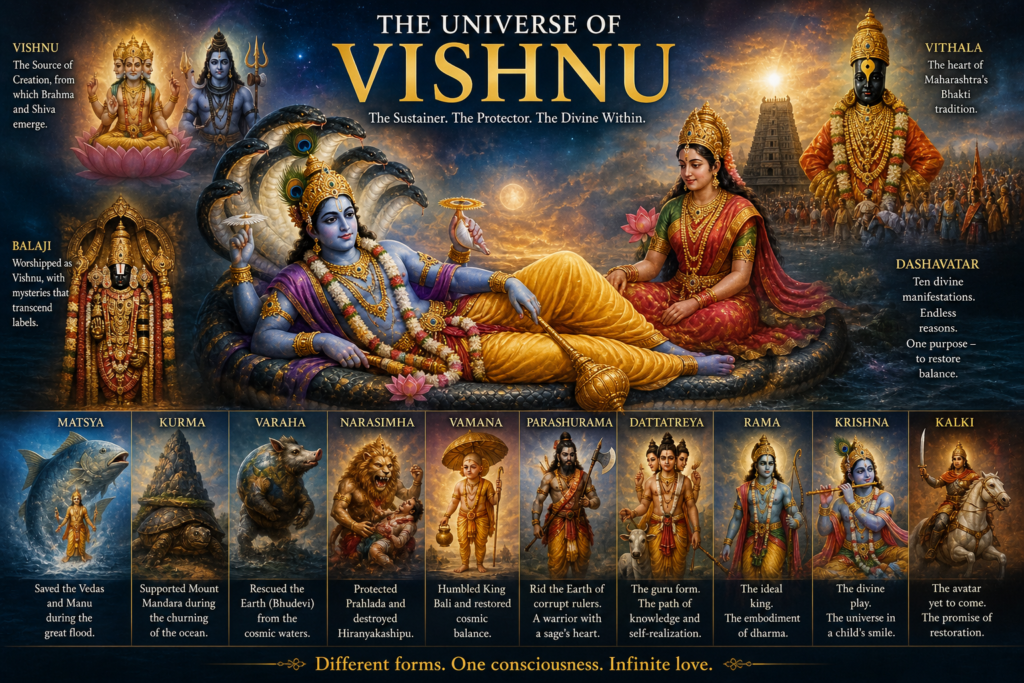
When most people think of Vishnu, they usually think of Rama or Krishna. But Vishnu’s story is far bigger than just his most famous avatars.
In this episode of TRS, the conversation explores the vast “Universe of Vishnu” — not just as a god in mythology, but as the cosmic force that sustains and balances creation itself.
The word Vishnu comes from Vishwam, meaning the universe, which perfectly reflects his nature. Vishnu is not simply a divine character in ancient stories—he is the force of preservation, balance, and expansion that keeps existence in motion.
Vishnu as the Source of Creation
One of the most fascinating ideas discussed in the episode is that Vishnu is not just part of creation—he is the source from which creation unfolds.
Drawing from the Vishnu Purana, the discussion describes Vishnu as the origin point from which even Brahma and Shiva emerge. This challenges the simplified way many people view Hindu deities separately.
Instead, the episode emphasizes a deeper spiritual truth:
The gods are different expressions of the same ultimate reality.
That idea was introduced beautifully through a symbolic story about Vishnu’s attendant attending Ganapati’s birthday—showing how divine forms may differ, but their source is one.
The Mystery of Balaji: Why Do Some See Shiva and Others Vishnu?
Another interesting topic covered was the identity of Balaji.
Though millions worship Balaji as a form of Vishnu, many devotees and scholars have pointed out that the idol also carries features associated with Shiva. Because of this, there have long been debates around whether Balaji is Vishnu, Shiva, or a form that transcends both labels.
According to tradition, Shri Ramanujacharya played a key role in establishing Balaji’s Vishnu identity. The famous story says he placed the conch and chakra before the deity, and the idol accepted Vishnu’s symbols—settling the debate for many devotees.
But perhaps the deeper lesson is this: divinity doesn’t always fit into rigid categories.
Vitthala and the Bhakti Heart of Maharashtra
The episode also touches on Vitthala, one of Maharashtra’s most beloved forms of Vishnu.
Vitthala worship is at the heart of the region’s Bhakti tradition. Every year, thousands of devotees walk for days to Pandharpur, singing Abhangas—devotional songs filled with longing, surrender, and love.
These pilgrimages are not just religious rituals. They are living examples of devotion in motion.
The Dashavatar: Vishnu’s Many Forms of Restoration
One of the strongest takeaways from the episode is that Vishnu’s avatars are not random mythological tales.
Each avatar appears when balance is lost—when dharma declines, when ego rises, or when the world needs correction.
And importantly, the Dashavatar should not always be viewed as a strict timeline. They are responses to cosmic need.
Matsya – The Fish Who Saved Knowledge
In the Matsya avatar, Vishnu appears as a fish during a great flood, saving Manu and rescuing the Vedas.
The story carries echoes of flood myths found across many civilizations and reminds us of Vishnu’s association with water—the primordial source of life.
Kurma – The Foundation Beneath Chaos
As Kurma, the tortoise, Vishnu supports Mount Mandara during the churning of the cosmic ocean.
It’s a powerful image: while gods and demons struggle above, Vishnu silently holds the entire process together from below.
Sometimes divinity is not in action—but in support.
Varaha – The One Who Lifts the Earth
When Earth sinks into the cosmic waters, Vishnu appears as Varaha, the boar, and lifts her back to safety.
Varaha represents protection, grounding, and Vishnu’s intimate connection with the Earth itself.
Narasimha – Divine Rage in Service of Love
Narasimha may be Vishnu’s most intense form.
Half-man, half-lion, he appears to protect Prahlada and destroy Hiranyakashipu—a tyrant who believed himself beyond death.
Narasimha reminds us that compassion and ferocity can coexist when protecting truth.
Vamana – Humility Over Pride
Vamana, the dwarf Brahmin, appears before King Bali and asks for three steps of land.
Then he expands to cosmic size and covers heaven and Earth in two steps, humbling Bali and restoring balance.
The lesson is simple but timeless:
Even virtue becomes dangerous when mixed with ego.
Parashurama – The Warrior Who Restored Justice
Parashurama is Vishnu’s fierce warrior avatar, appearing to destroy corrupt rulers when power had become abusive.
His story carries themes of justice, discipline, and divine anger used in service of righteousness.
Dattatreya – The Guru Form
Though not traditionally counted in every Dashavatar list, the episode also explores Dattatreya—the combined form of Brahma, Vishnu, and Shiva.
Dattatreya represents the path of inner knowledge and self-realization.
He is not a warrior or king, but a teacher.
Rama and Krishna: The Avatars Beyond Summary
The episode only briefly touches on Rama and Krishna, acknowledging that their stories are too vast for a short discussion.
One memorable mention is the story of young Krishna eating mud and showing Yashoda the entire universe inside his mouth.
A child containing the cosmos.
A reminder that the infinite can exist within the smallest form.
Kalki: The Avatar Yet to Come
The conversation ends the Dashavatar journey with Kalki, the future avatar prophesied to appear at the end of Kali Yuga.
Kalki represents the idea that whenever darkness reaches its peak, restoration will come.
Vishnu’s Real Teaching: The Divine Meets You Where You Are
Perhaps the most beautiful message from the episode is this:
Vishnu is not limited to one form.
He appears however the devotee needs him—
- As strength for the weak
- Wisdom for the confused
- Protection for the fearful
- Love for the devoted
That is why Vishnu’s forms are so diverse.
Because human needs are diverse.
Final Thoughts
The Universe of Vishnu is not just mythology.
It is philosophy, psychology, devotion, and cosmic symbolism woven into story.
Each avatar reflects something within us:
- Our pride
- Our fear
- Our devotion
- Our struggle
- Our need for balance
And maybe that is why Vishnu remains so deeply relevant even today.
Because his stories are not just about gods.
They are about us.