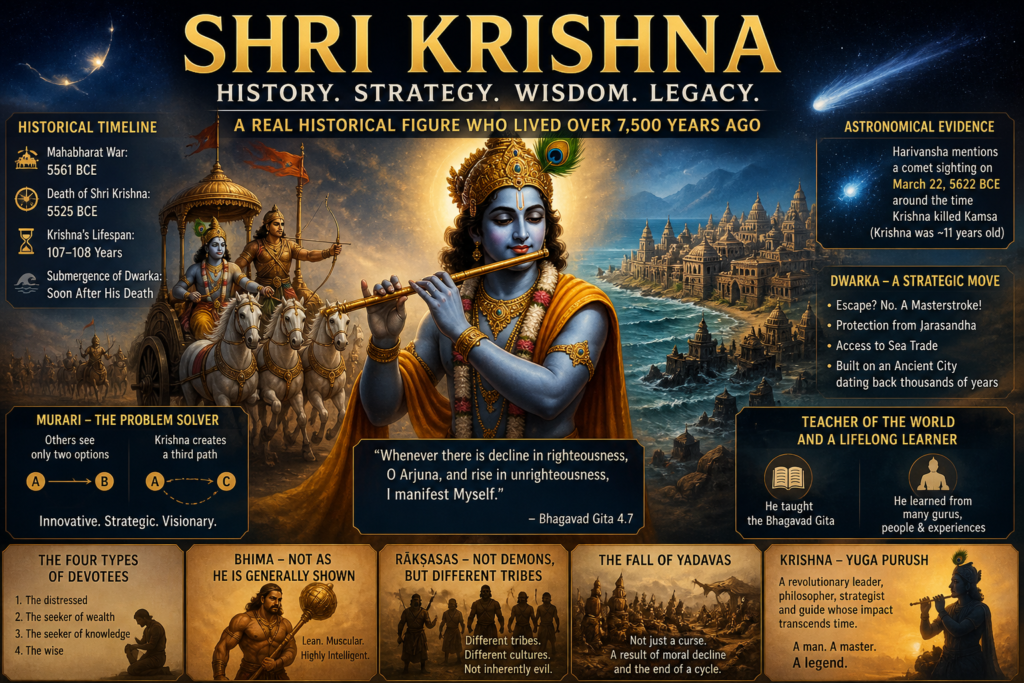
For millions, Shri Krishna is the divine guide of the Bhagavad Gita, the playful child of Vrindavan, and the strategist of the Mahabharat. But what if Krishna was not only a spiritual symbol—but also a real historical figure?
In a thought-provoking episode of The Ranveer Show (TRS), researcher N. S. Oak presents a bold and fascinating argument: Shri Krishna lived over 7,500 years ago, and his life can be traced through astronomy, geography, and ancient Indian texts.
If true, this would reshape how we understand Indian civilization and challenge long-held assumptions about mythology and history.
Did Shri Krishna Really Exist?
According to N. S. Oak, the answer is yes.
He argues that Krishna was a real historical personality, not merely a mythological character. His claim rests on what he describes as a combination of:
- Astronomical evidence from ancient scriptures
- Geographical and terrestrial observations
- Chronological consistency across Indian texts
Oak’s broader mission is to challenge the belief that ancient India lacked reliable historical records.
“India’s history may be far more documented than we’ve been taught.”
When Did Shri Krishna Live? Historical Timeline Explained
Based on Oak’s research:
- Mahabharat War: 5561 BCE
- Death of Shri Krishna: 5525 BCE
- Submergence of Dwarka: Shortly after Krishna’s death
This places Krishna’s life more than 7,500 years in the past.
According to scriptural chronology, Krishna lived for approximately 107–108 years, aligning with age references of other Mahabharat figures like Arjuna and Bhishma.
Astronomical Evidence Used to Date Krishna’s Life
One of the strongest claims in the episode involves astronomical dating.
Oak references descriptions from the Harivansha, which mention a comet sighting on March 22, 5622 BCE around the time Krishna killed Kamsa.
Because Krishna is believed to have been around 11 years old then, Oak estimates his birth year accordingly.
This method of using planetary alignments and celestial events to date ancient texts has become central to Oak’s research.
Was Krishna Born During a Storm? A Different Historical Interpretation
Popular stories depict Krishna’s birth during a dramatic monsoon night with thunder, rain, and the overflowing Yamuna River.
But Oak challenges that narrative.
He notes that scriptural descriptions from the Harivansha mention:
- Dry riverbanks
- Dung visible on roads
- Conditions inconsistent with heavy rainfall
This suggests the popular version may be symbolic, while the original descriptions point to a different reality.
Why Krishna Was More Than a Spiritual Figure
What makes Krishna extraordinary is not just his divinity—but his mind.
Oak portrays Krishna as one of history’s greatest strategic thinkers.
He uses the term “Murari” to describe Krishna’s unique approach:
When others saw only two choices, Krishna found a third path.
This mindset defined Krishna’s leadership in:
- Politics
- Warfare
- Diplomacy
- Ethical dilemmas
His brilliance was not brute force—but intelligent strategy.
Krishna’s Move from Mathura to Dwarka: Strategy Over Escape
Many view Krishna’s departure from Mathura as retreat.
Oak argues it was strategic genius.
Faced with repeated attacks from Jarasandha, Krishna relocated his people to Dwarka, a fortified coastal kingdom.
Why Dwarka Made Sense Strategically
- Better defensive position
- Access to maritime trade routes
- Protection from repeated invasions
- Foundation for a prosperous kingdom
What seemed like retreat was actually long-term strategic vision.
The Real Meaning of Jagat Guru
Krishna is often called Jagat Guru—Teacher of the World.
But Oak offers a deeper interpretation.
Jagat Guru can also mean:
“One who learns from the world.”
Krishna was not only a teacher—he was a lifelong learner.
He absorbed wisdom from:
- Nature
- Teachers
- Warriors
- Saints
- Experience
This made him adaptable, wise, and deeply human.
Krishna’s Philosophy: Balance of Knowledge, Action, and Devotion
In the Bhagavad Gita, Krishna explains that human beings approach the divine in different ways.
He identifies four kinds of devotees:
- The distressed
- The seeker of wealth
- The seeker of knowledge
- The wise
But Krishna’s core teaching is synthesis:
True fulfillment comes from balancing:
- Jnana (Knowledge)
- Karma (Action)
- Bhakti (Devotion)
This integrated philosophy remains one of his most enduring contributions to human thought.
Reimagining Epic Characters: Bhima and the Rakshasas
The episode also challenges modern portrayals of Mahabharat characters.
Bhima Was Not Overweight
Contrary to popular visual depictions:
- Bhima was lean and muscular
- Exceptionally athletic
- Highly intelligent and perceptive
Rakshasas May Have Been Tribal Communities
Oak suggests Rakshasas may not have been literal demons, but:
- Distinct tribes
- Cultural outsiders
- Communities mythologized over time
This interpretation reframes epic history through a more anthropological lens.
Why the Yadava Clan Was Destroyed
The fall of the Yadavas is often attributed to curses in traditional storytelling.
Oak offers another perspective:
Their destruction may reflect:
- Moral decay
- Internal corruption
- Social degeneration
Krishna, recognizing this decline, may have accepted their fall as part of a necessary civilizational reset.
Final Thoughts: Why Krishna Still Matters Today
Whether one sees Krishna as God, man, or both—his legacy remains unmatched.
If N. S. Oak’s interpretation is correct, then Shri Krishna was not merely a mythological figure, but:
- A real historical leader
- A revolutionary strategist
- A philosopher ahead of his time
- A spiritual guide whose teachings transcend centuries
Krishna’s life is not just a story of divinity.
It is a story of leadership, wisdom, sacrifice, strategy, and transformation.
And perhaps that is why, thousands of years later, the world still calls him:
Yuga Purush — The Man of the Age