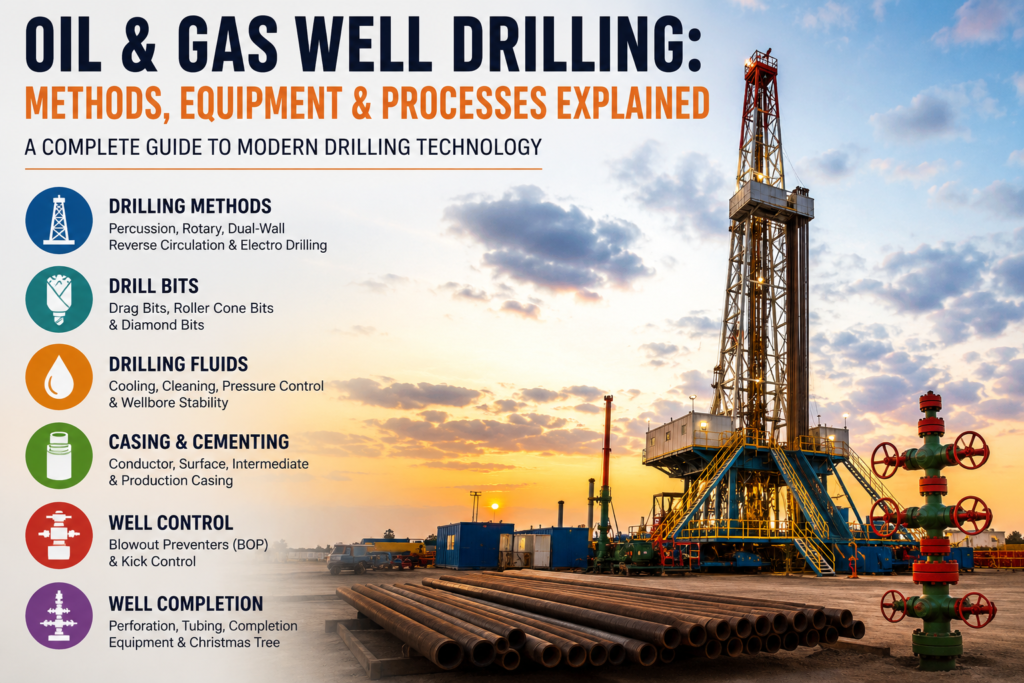
Understanding Oil & Gas Well Drilling: Methods, Equipment, and Processes
The exploration and production of oil and natural gas depend heavily on efficient drilling operations. Before hydrocarbons can be extracted from deep underground reservoirs, engineers must carefully plan and execute a complex drilling process. Modern drilling technology has evolved significantly, allowing operators to drill deeper, safer, and more accurately than ever before.
In this article, we explore the major drilling methods, drilling rig components, drilling fluids, casing systems, well control equipment, and well completion processes used in the petroleum industry.
What is a Drilling Rig?
A drilling rig is an integrated system designed to create boreholes in the Earth’s surface for the extraction of oil, natural gas, or water. These rigs can range from small portable units used for shallow wells to massive structures capable of drilling several miles beneath the Earth’s surface.
Drilling rigs are generally classified into:
Onshore Rigs
Used on land-based drilling locations.
Offshore Rigs
Used in oceans and seas where petroleum reservoirs exist beneath the seabed. Offshore rigs include:
- Drilling Barges (shallow waters)
- Jack-Up Rigs
- Semi-Submersible Rigs
- Drillships (deepwater operations)
Major Well Drilling Methods
1. Percussion (Cable Tool) Drilling
Percussion drilling is one of the oldest drilling techniques. A heavy drill bit attached to a cable repeatedly strikes the ground, breaking the rock formation.
Advantages:
- Simple design
- Suitable for shallow wells
- Effective in unconsolidated formations
Limitations:
- Slow drilling speed
- Limited depth capability
Historically, Colonel Edwin Drake drilled the first commercial oil well in the United States in 1859 using this method.
2. Rotary Drilling
Rotary drilling revolutionized the petroleum industry. Instead of repeatedly striking the formation, the drill bit rotates continuously while applying downward force.
Key components include:
- Derrick
- Rotary table
- Kelly
- Drill pipe
- Drill bit
This method allows wells to be drilled thousands of feet deep and remains the most widely used drilling technique today.
3. Dual-Wall Reverse Circulation Drilling
This technique uses concentric pipes where drilling fluid travels downward through one passage and returns through another.
Benefits include:
- Faster drilling rates
- Continuous removal of cuttings
- Better sample recovery
- Improved drilling efficiency
4. Electro Drilling
Electro drilling uses electric motors to power drilling equipment.
Advantages:
- Improved control
- Remote operation capability
- Higher efficiency
- Suitable for complex geological formations
Electro drilling also enables advanced directional and horizontal drilling operations.
Directional and Horizontal Drilling
Modern petroleum reservoirs often require more than simple vertical wells.
Directional Drilling
Directional drilling allows engineers to intentionally steer the wellbore toward specific underground targets.
Benefits:
- Access difficult reservoirs
- Reduce drilling costs
- Increase reservoir exposure
- Reach offshore reservoirs from a single platform
Horizontal Drilling
After reaching a certain depth vertically, the well is gradually turned horizontally within the productive reservoir zone.
This significantly increases contact with the reservoir and boosts production rates.
Multilateral Wells
Multiple horizontal branches can be drilled from a single main wellbore, maximizing reservoir coverage while minimizing surface infrastructure.
Drill Bits: The Cutting Tool
The drill bit is located at the bottom of the drilling string and performs the actual rock-cutting operation.
Common types include:
Drag Bits
Use shearing action to cut formations.
Roller Cone Bits
Crush and chip rock using rotating cones.
Diamond Bits
Contain industrial diamonds and are ideal for extremely hard formations.
Diamond bits can be 40–50 times harder than conventional steel bits, making them highly effective in challenging drilling conditions.
Drilling Mud and Its Functions
Drilling mud, or drilling fluid, is one of the most important elements in drilling operations.
The fluid may consist of:
- Water
- Bentonite clay
- Chemical additives
- Synthetic fluids
Main Functions of Drilling Mud
Cooling the Drill Bit
Continuous circulation prevents overheating.
Removing Rock Cuttings
Carries drilled rock fragments to the surface.
Maintaining Well Stability
Balances formation pressures and prevents well collapse.
Pressure Control
Helps prevent dangerous blowouts.
The drilling fluid circulates down through the drill pipe and returns to the surface through the annular space between the drill pipe and wellbore.
Well Casing System
As drilling progresses, steel casing pipes are installed to strengthen and protect the well.
Conductor Casing
Provides initial structural support.
Surface Casing
Protects freshwater zones from contamination.
Intermediate Casing
Controls formation pressures and prevents wellbore instability.
Production Casing
Installed in the reservoir zone and used during production operations.
After installation, each casing section is cemented in place to ensure proper isolation and structural integrity.
Blowout Prevention and Well Control
One of the biggest risks during drilling is uncontrolled flow from high-pressure formations.
This sudden influx of formation fluids is called a kick.
If not controlled, a kick can lead to a blowout, which may cause:
- Equipment damage
- Environmental disasters
- Human casualties
Blowout Preventer (BOP)
A Blowout Preventer is a specialized safety device installed at the wellhead.
Functions:
- Seal the well
- Control pressure
- Prevent uncontrolled fluid release
Modern BOP systems use hydraulic pressure and can quickly shut in a well during emergencies.
Important Drilling Rig Components
A drilling rig contains numerous systems working together.
Power System
Provides energy to drilling operations.
Hoisting System
Raises and lowers drill pipes, casing, and equipment.
Key parts:
- Derrick
- Crown block
- Traveling block
- Drawworks
Rotary System
Transfers rotational energy to the drill bit.
Includes:
- Rotary table
- Kelly
- Drill pipe
- Drill collars
Circulating System
Moves drilling fluid through the well.
Components:
- Mud pumps
- Mud tanks
- Mud treatment equipment
Monitoring System
Tracks critical parameters such as:
- Depth
- Penetration rate
- Torque
- Pump pressure
- Mud density
- Mud temperature
Cementing Operations
After casing installation, cement slurry is pumped into the annular space between the casing and the wellbore.
The objectives are:
- Secure casing in place
- Prevent fluid migration
- Protect groundwater
- Improve well integrity
Proper cementing is critical for safe and efficient well operation.
Well Completion
Once drilling reaches the target reservoir and evaluations confirm hydrocarbon presence, the well enters the completion stage.
Completion activities include:
- Installing production tubing
- Perforating the casing
- Installing downhole equipment
- Testing production capability
At this stage, the drilling rig is removed, and production equipment is installed.
The Christmas Tree
The visible equipment at the surface of a completed well is called the Christmas Tree.
Functions:
- Control production flow
- Monitor well pressure
- Provide safety shutdown mechanisms
- Direct hydrocarbons to processing facilities
The Christmas Tree acts as the operational control center of the producing well.
Conclusion
Oil and gas well drilling is a highly sophisticated engineering process involving advanced technology, specialized equipment, and strict safety systems. From selecting the drilling location to well completion and production, every stage plays a critical role in ensuring efficient hydrocarbon recovery.
Modern innovations such as directional drilling, horizontal wells, advanced drilling fluids, and sophisticated well-control systems have dramatically improved drilling success rates while reducing costs and operational risks. As energy demand continues to grow, drilling technology will remain at the heart of petroleum exploration and production.