Source Note
This blog post is a summary of the book:
- Title: Notes on Indian History (664–1858)
- Author: Karl Marx
- First Published: 1906 (compiled and published posthumously from Karl Marx’s historical writings)
- Publisher: N.C. Ray, Calcutta (later reprinted by various publishers)
This article is intended for educational and reference purposes only. All credit for the original historical analysis goes to Karl Marx.
Part 2: The Mughal Zenith and the Age of Aurangzeb (1526–1707)
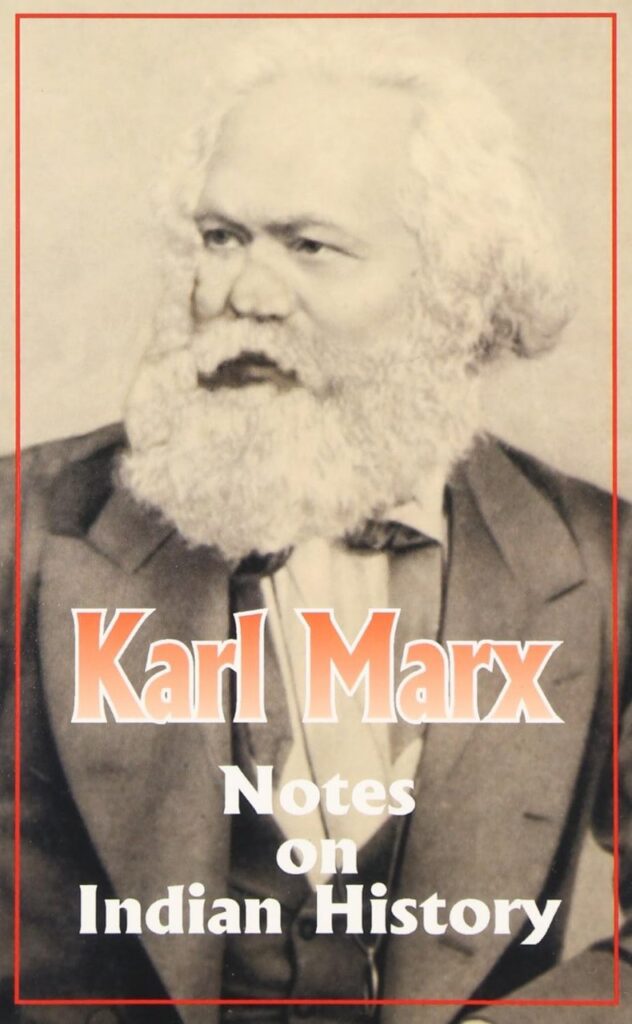
📖 This is the cover of Karl Marx’s book Notes on Indian History (664–1858), first published in 1906. The book traces India’s history from early Muslim invasions to the Revolt of 1857, reflecting Marx’s perspective on India’s political and colonial past.
Introduction
Karl Marx’s Notes on Indian History (664–1858) traces the transformation of India from the early Muslim invasions to the British conquest. This first section (664–1707) covers more than a millennium of change – beginning with Arab raids in Sindh, the rise and fall of Delhi Sultanate dynasties, and culminating in the glory and decline of the Mughal Empire under Aurangzeb.
It is a story of invasions, dynasties, cultural synthesis, and conflicts that shaped the subcont
The Mughal Empire: Foundation & Expansion (1526–1658)
(Chapters: Babur to Shah Jahan)
Babur (1526–1530): The Founder of Mughal Power
- Babur, descended from Timur and Genghis Khan, came from Ferghana (Central Asia).
- Invited by Indian nobles, he marched into India and defeated Ibrahim Lodi in the First Battle of Panipat (1526), where field artillery decided the outcome.
- Battle of Khanwa (1527): Defeated Rana Sanga of Mewar, cementing Mughal control.
- Battle of Ghagra (1529): Secured Bihar and Bengal.
- His memoir, the Baburnama, gives vivid insights into 16th-century India.
Humayun (1530–1556): The Struggler King
- Suffered repeated setbacks against Afghan and Rajput chiefs.
- Defeated by Sher Shah Suri at Kannauj (1540) → forced into Persian exile.
- Sher Shah’s Legacy:
- Introduced revenue reforms, standardized coinage (Rupiya), postal network.
- Built the Grand Trunk Road.
- Humayun regained the throne briefly in 1555 but died a year later, leaving a fragile empire to his son Akbar.
Akbar the Great (1556–1605): Empire Builder
- At just 13, secured power after the Second Battle of Panipat (1556) against Hemu.
- Expanded into Gujarat, Bengal, Kashmir, Sindh, and parts of the Deccan.
- Administration:
- Mansabdari system to rank nobles.
- Revenue reforms under Raja Todar Mal (Zabt system).
- Religious Policy:
- Abolished jizya tax, promoted tolerance.
- Founded Din-i-Ilahi, a syncretic faith.
- Held multi-faith debates at the Ibadat Khana, Fatehpur Sikri.
- Culture:
- Sponsored translations of Sanskrit epics into Persian.
- Patron of miniature painting and architecture.
Jahangir (1605–1627): The Patron of Arts
- Famous for his love of painting, gardens, and refinement.
- Faced revolts but maintained control with diplomacy.
- Allowed English East India Company to set up factories (1615).
- Sir Thomas Roe’s embassy (1615–1619) opened Indo-English trade ties.
Shah Jahan (1628–1658): The Builder Emperor
- His reign marked the golden age of Mughal architecture.
- Built Taj Mahal, Red Fort, and Jama Masjid.
- Expanded into Deccan, Kandahar, Balkh → but costly wars strained finances.
- Succession war among his sons ended with Aurangzeb seizing power in 1658.
The Rule of Aurangzeb & the Rise of Regional Powers (1658–1707)
(Chapters: Reign of Aurangzeb and Rise of the Marathas)
Aurangzeb (1658–1707): The Orthodox Emperor
- Seized power after defeating brother Dara Shikoh at the Battle of Samugarh (1658).
- Expanded empire to its largest size, annexing Bijapur and Golconda.
Policies:
- Re-imposed jizya on non-Muslims.
- Ordered destruction of several Hindu temples.
- Reduced patronage of music and arts, emphasizing strict orthodoxy.
Major Challenges:
- Marathas:
- Shivaji (1630–1680): Master of guerrilla tactics, created a navy, crowned Chhatrapati in 1674.
- After Shivaji, Sambhaji and Rajaram continued Maratha resistance → draining Mughal resources.
- Sikhs:
- Guru Tegh Bahadur executed (1675).
- Guru Gobind Singh created the Khalsa in 1699 → militarized Sikh community.
- Rajputs:
- Mewar and Marwar resisted imperial interference, ending Mughal-Rajput alliance.
- Other Revolts: Jats, Satnamis, and Afghans rose against Mughal authority.
Decline:
- Continuous wars in the Deccan depleted treasury.
- By Aurangzeb’s death (1707), empire was vast but hollow, beset by rebellions, weak administration, and economic strain.
Conclusion
Between 1526 and 1707, the Mughal Empire rose to political and cultural greatness under rulers like Akbar and Shah Jahan, but collapsed into internal strife under Aurangzeb.
- Expansion brought prestige, but overextension brought exhaustion.
- Tolerance and syncretism gave way to orthodoxy and rebellion.
The stage was set for the rise of Marathas, Sikhs, Nawabs, and European trading companies, who would dominate the 18th century.
📜 Timeline of the Mughal Empire (1526–1707)
- 1526 – First Battle of Panipat: Babur defeats Ibrahim Lodi → Mughal Empire founded.
- 1527 – Battle of Khanwa: Babur defeats Rana Sanga of Mewar.
- 1529 – Battle of Ghagra: Babur secures Bihar and Bengal.
- 1540 – Battle of Kannauj: Humayun defeated by Sher Shah Suri; Mughal rule interrupted.
- 1545 – Sher Shah dies; his successors fail to hold power.
- 1555 – Humayun regains Delhi.
- 1556 – Humayun dies; Akbar becomes emperor after the Second Battle of Panipat (victory over Hemu).
- 1576 – Battle of Haldighati: Akbar defeats Maharana Pratap of Mewar.
- 1605 – Death of Akbar; Jahangir becomes emperor.
- 1615–1619 – Sir Thomas Roe’s embassy at Jahangir’s court → English trading rights established.
- 1628 – Shah Jahan ascends the throne; begins golden age of Mughal architecture.
- 1632–1648 – Taj Mahal constructed at Agra.
- 1658 – Aurangzeb defeats Dara Shikoh at the Battle of Samugarh; seizes throne.
- 1674 – Shivaji crowned Chhatrapati of the Maratha Empire.
- 1675 – Execution of Guru Tegh Bahadur (9th Sikh Guru).
- 1699 – Guru Gobind Singh forms the Khalsa, militarizing the Sikh community.
- 1707 – Death of Aurangzeb; Mughal Empire begins to decline.
📊 Key Battles of the Mughal Period (1526–1707)
| Year | Battle | Opponents | Outcome & Significance |
|---|---|---|---|
| 1526 | First Battle of Panipat | Babur vs Ibrahim Lodi | Babur wins → Mughal Empire founded. |
| 1527 | Battle of Khanwa | Babur vs Rana Sanga (Mewar) | Babur victorious; Rajput power weakened. |
| 1529 | Battle of Ghagra | Babur vs Afghan chiefs | Consolidated control over eastern India. |
| 1540 | Battle of Kannauj (Bilgram) | Humayun vs Sher Shah Suri | Humayun defeated → Sur Empire established. |
| 1556 | Second Battle of Panipat | Akbar (Bairam Khan) vs Hemu | Akbar secures throne at age 13. |
| 1576 | Battle of Haldighati | Akbar vs Maharana Pratap | Mughals win; Rajput resistance continues. |
| 1658 | Battle of Samugarh | Aurangzeb vs Dara Shikoh | Aurangzeb emerges victorious; becomes emperor. |
| 1674–1707 | Maratha–Mughal Wars | Shivaji, Sambhaji, Rajaram vs Aurangzeb | Guerrilla warfare drains Mughal treasury. |
| 1675–1707 | Sikh Resistance | Sikh Gurus vs Aurangzeb | Growth of Khalsa; rising Sikh military power. |