Discover the fundamentals of petroleum reservoir engineering — from how oil and gas form underground to primary, secondary, and tertiary recovery methods. A clear, beginner-friendly guide by IIT Guwahati.
Petroleum Reservoir Engineering: Everything You Need to Know to Get Started
If you’ve ever wondered how oil and gas travel from thousands of feet underground to the fuel in your car or the gas in your stove, you’re in the right place. Petroleum reservoir engineering is the discipline that makes that journey possible — and profitable.
This guide breaks down the core concepts of reservoir engineering in plain language, whether you’re a petroleum engineering student, a professional working in flow through porous media, or simply someone curious about where fossil fuels come from.
What Is Petroleum Reservoir Engineering?
Petroleum reservoir engineering is defined as the art of developing and producing oil and gas fluids in a manner that maximizes hydrocarbon recovery and revenue generation.
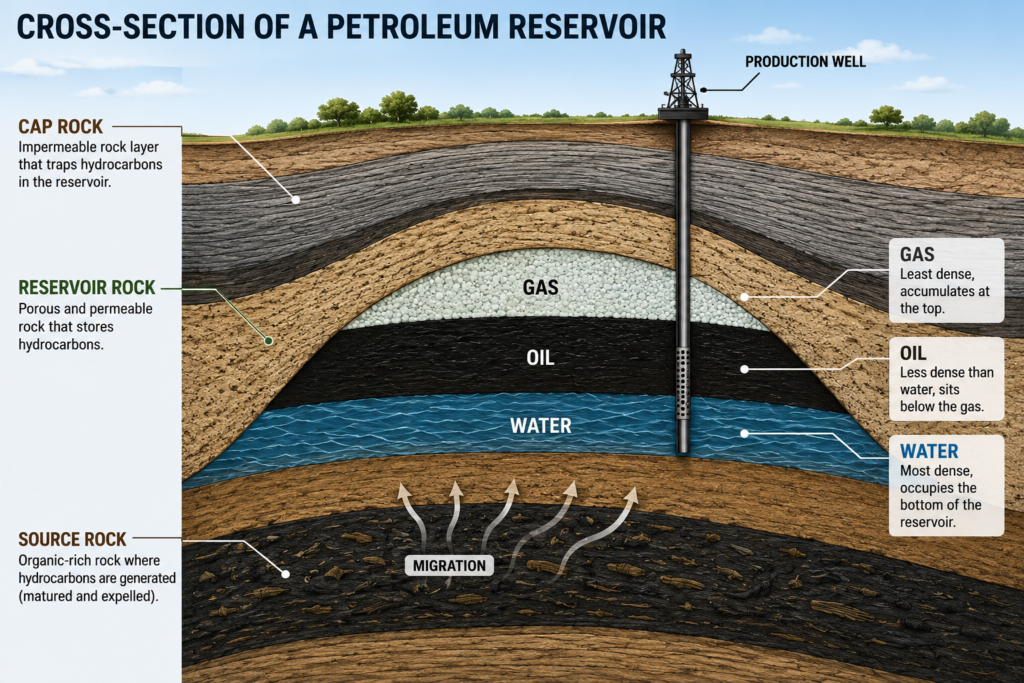
Unlike a surface water reservoir you can see and measure directly, a petroleum reservoir is hidden beneath the earth — a porous and permeable rock formation that traps crude oil and natural gas under enormous pressure.
Two properties define every petroleum reservoir:
- Porosity — how much fluid the rock can hold
- Permeability — how easily that fluid can flow through the rock
Think of porosity as the storage capacity of a sponge, and permeability as how quickly water moves through it. Both properties are critical to determining how productive a reservoir will be.
Conventional vs. Unconventional Reservoirs
Not all oil and gas reservoirs are created equal. Engineers broadly classify them into two categories:
Conventional Reservoirs
These reservoirs produce hydrocarbons at profitable rates naturally, without requiring special intervention. Standard drilling techniques are enough to get the fluid flowing to the surface.
Unconventional Reservoirs
These require additional or specialized techniques to extract hydrocarbons at a commercially viable rate. The permeability in unconventional reservoirs is extremely low — meaning the oil or gas simply won’t flow fast enough on its own. Examples include shale gas, tight oil, and coal-bed methane formations.
The key difference isn’t just technology — it’s also the type of fluid present, the permeability of the rock, and the economics of extraction.
How Is Oil and Gas Produced? The End-to-End Process
Getting hydrocarbons from deep underground to a consumer’s hands involves many coordinated steps:
- Exploration — Identifying potential drilling sites through geological and geophysical surveys
- Drilling — Boring a vertical (or directional) well from the surface to the reservoir
- Well Completion — Installing the “Christmas tree” (the surface valve assembly that controls and monitors production)
- Extraction — Bringing reservoir fluids to the surface
- Separation — Separating oil, gas, and water at the surface using separators
- Transportation — Moving crude oil and gas via pipelines to refineries and processing plants
- Refining and Distribution — Processing and delivering the final product to end users
The Anatomy of a Petroleum Production System
Picture three zones working together:
- The Reservoir — Deep underground, storing oil, gas, and water in porous rock at very high pressure (often several thousand feet below surface)
- The Wellbore — The drilled channel connecting the reservoir to the surface
- The Christmas Tree — The surface equipment that monitors flow rate, controls pressure, and ensures safety
Because water is densest, it settles at the bottom of the reservoir. Oil floats above it, and gas sits at the very top. When the well is drilled and production begins, the pressure difference between the reservoir and the wellbore drives fluid upward.
Engineers describe this system using three performance relationships:
| Relationship | Abbreviation | What It Describes |
|---|---|---|
| Inflow Performance Relationship | IPR | Flow rate vs. pressure in the reservoir |
| Wellbore Performance Relationship | WPR/TPR | Flow rate vs. pressure from wellbore to surface |
| Choke Performance Relationship | CPR | Flow rate vs. pressure at the surface choke valve |
How Do We Classify a Reservoir? Key Indicators
Gas-Oil Ratio (GOR)
Once oil, gas, and water are separated at the surface, the ratio of gas to oil produced helps identify what type of well has been drilled:
- GOR > 100,000 SCF/STB → Gas well
- GOR < 5,000 SCF/STB → Oil well
- GOR between 5,000 and 100,000 SCF/STB → Condensate well
This classification directly determines what surface facilities are needed. Gas wells, for example, require on-site processing equipment, while crude oil is typically sent to a remote refinery.
API Gravity
API gravity measures the density of the crude oil produced:
- 0–20° API → Heavy crude oil
- 20–30° API → Medium crude oil
- Above 30° API → Light crude oil
Light crude oils are generally more valuable because they require less refining to yield high-quality products like gasoline and jet fuel.
The Three Stages of Hydrocarbon Recovery
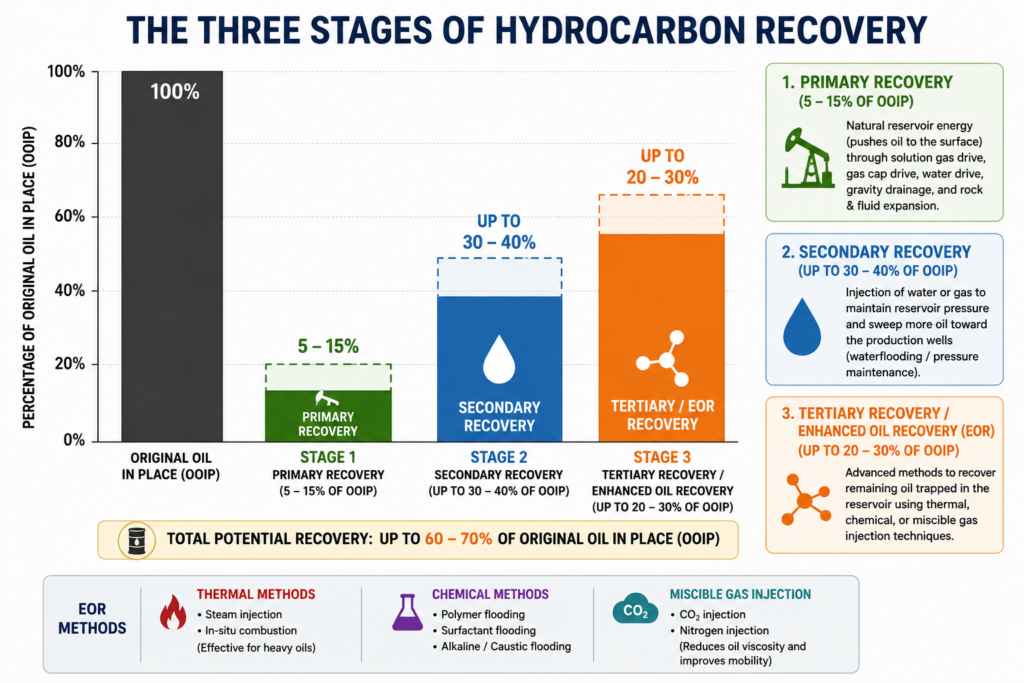
Primary Recovery (5–15% of Original Oil in Place)
The reservoir’s natural pressure drives oil and gas to the surface without any artificial assistance. Over time, this pressure depletes, and flow rates drop.
Several natural drive mechanisms contribute to primary recovery:
- Solution gas drive — dissolved gas expands and pushes oil
- Gas cap drive — free gas at the top of the reservoir expands
- Water drive — an adjacent aquifer pushes water into the reservoir, displacing oil upward
- Gravity drainage — oil drains downward due to gravity
- Rock and fluid expansion — the rock itself and the fluids expand slightly as pressure drops
Secondary Recovery (up to 30–40% of OOIP)
When natural pressure declines too much, engineers inject fluids — typically water or gas — to maintain reservoir pressure and continue production. This is called pressure maintenance or waterflooding.
Tertiary Recovery / Enhanced Oil Recovery (EOR)
Even after secondary recovery, a significant portion of oil remains trapped in the rock due to capillary forces, viscosity effects, or complex pore geometry. Tertiary (or EOR) methods target this remaining oil using:
- Thermal methods — steam injection, in-situ combustion (particularly effective for heavy oils)
- Chemical methods — polymer flooding, surfactant flooding, alkaline/caustic flooding
- Miscible gas injection — CO₂ or nitrogen injected to mix with oil and reduce viscosity
Where Does Oil Come From? The Geology Behind It
Oil and gas are fossil fuels — formed from organic matter (marine organisms, algae, plant debris) buried under sediment over millions of years. Under the right conditions of temperature and pressure, this organic matter converts into hydrocarbons through biological, thermal, and chemical processes.
Three rock types must be present for a viable petroleum reservoir to exist:
- Source Rock — Where organic material accumulates and transforms into oil and gas over geological time
- Reservoir Rock — The porous and permeable rock where migrating hydrocarbons accumulate and are stored
- Cap Rock (Seal) — A highly impermeable layer sitting above the reservoir rock that prevents hydrocarbons from escaping upward
Without all three, oil and gas simply won’t accumulate in commercially extractable quantities.
How Depth Affects Reservoir Properties
As you drill deeper, conditions change significantly:
| Depth | Porosity | Permeability | Expected Fluid |
|---|---|---|---|
| ~1,000 ft | ~30% | ~10,000 mD | Heavy oil |
| ~10,000 ft | ~15% | 10–100 mD | Light oil |
| ~20,000 ft | ~10% | ~0.1 mD | Natural gas |
Greater depth means higher temperature and pressure, which compresses the rock (reducing porosity and permeability) and drives the conversion of organic matter toward lighter hydrocarbons — eventually natural gas.
Key Reservoir Fluid Types
Reservoir fluids are classified based on how compressible they are under pressure:
- Incompressible fluids — Density doesn’t change with pressure. Water is treated as approximately incompressible in most engineering calculations.
- Slightly compressible fluids — Density changes linearly with pressure. Crude oil falls into this category.
- Compressible fluids — Density changes significantly and non-linearly with pressure. Natural gas is highly compressible.
Understanding compressibility is essential for setting up the equations that govern how fluids flow through the reservoir.
Flow Regimes in a Reservoir
Pressure in a producing reservoir changes over time. How it changes determines the flow regime:
- Steady-State Flow — Pressure at any point in the reservoir remains constant over time. This is a theoretical simplification used in certain calculations.
- Pseudo-Steady State (Semi-Steady State) — Pressure declines at a constant rate everywhere in the reservoir. This is the most common flow condition during normal production.
- Unsteady-State (Transient) Flow — Pressure changes both with time and location in a complex, non-linear way. This occurs when a well is first opened or after any sudden change in production rate.
Reservoir Geometry and Flow Patterns
The physical shape of the reservoir — and the position of the production well within it — determines how fluid flows:
- Radial Flow — Fluid flows from all directions toward the wellbore (the most common assumption for vertical wells)
- Linear Flow — Fluid flows in one direction only (common in hydraulically fractured wells or narrow channel reservoirs)
- Spherical Flow — Occurs when only a small portion of the reservoir thickness is perforated
- Hemispherical Flow — Fluid approaches from all directions toward the bottom of an open wellbore
For most analytical calculations, radial and linear flow models are used. Complex geometries require numerical simulation.
Darcy’s Law: The Fundamental Equation of Reservoir Flow
Everything in reservoir engineering flows (literally) from one foundational principle: Darcy’s Law, developed by Henry Darcy in 1856.
Darcy discovered — through sand pack experiments for water purification — that the velocity of a fluid through a porous medium is:
- Proportional to the pressure gradient driving it
- Inversely proportional to the fluid’s viscosity
The relationship also includes permeability — a property of the rock itself that describes how easily fluid passes through it. Permeability is measured in Darcies or, more commonly, milliDarcies (mD).
Darcy’s Law applies when:
- Flow is laminar (not turbulent)
- The fluid is incompressible
- Flow is at steady state
- The rock is homogeneous and isotropic
For compressible fluids like gas, or for high-velocity flow near the wellbore, corrections to Darcy’s Law are applied.
Units in Petroleum Engineering: The U.S. Field Unit System
Petroleum engineering uses its own hybrid unit system — not SI, not CGS — called the U.S. Field Unit System. Being comfortable with it is non-negotiable for solving practical problems.
Key units include:
| Parameter | U.S. Field Unit |
|---|---|
| Flow rate (liquid) | Stock Tank Barrels per Day (STB/day) |
| Flow rate (gas) | Standard Cubic Feet per Day (SCF/day) |
| Pressure | Pounds per Square Inch (psi) |
| Viscosity | Centipoise (cp) |
| Length/depth | Feet (ft) |
| Area | Acres |
| Permeability | Millidarcy (mD) |
One barrel = 42 U.S. gallons = 158.99 liters. It’s worth knowing that 1 U.S. gallon = 3.785 liters, while 1 Imperial (UK) gallon = 4.546 liters — a distinction that matters when comparing international data.
Numerical Methods Used in Reservoir Engineering
Newton-Raphson Method
When reservoir equations become complex, engineers need numerical tools to find solutions. The Newton-Raphson method solves equations of the form f(x) = 0 through an iterative approach:
- Rearrange your equation so everything equals zero
- Choose an initial guess
- Calculate the next approximation using: x(n+1) = x(n) − f(x(n)) / f'(x(n))
- Check if the error is acceptable; if not, repeat
This method converges quickly and can be implemented easily in Excel using the Goal Seek function (Data → What-If Analysis → Goal Seek).
Trapezoidal Rule (Numerical Integration)
When you need to integrate a complex function — say, calculating cumulative production over time — the trapezoidal rule offers a straightforward approach. You divide the area under the curve into equally-spaced segments and sum the areas of the trapezoids formed. The more segments you use, the more accurate your result.
The Reservoir Engineering Team: It’s Not a Solo Job
Successful reservoir management requires professionals from multiple disciplines:
- Geologists & Geophysicists — Identify and characterize reservoir structures
- Drilling Engineers — Design and execute the drilling program
- Reservoir Engineers — Model fluid flow, design recovery strategies, forecast production
- Production Engineers — Optimize surface facilities and wellbore performance
- Economists — Evaluate project profitability and investment decisions
- Environmental Engineers — Ensure compliance and minimize environmental impact
- Legal & Land Teams — Handle mineral rights and regulatory approvals
Key Takeaways
- A petroleum reservoir is an underground porous rock formation — not a simple pool of oil
- Porosity and permeability are the two most critical reservoir rock properties
- Hydrocarbons form from organic matter over millions of years and migrate to reservoir rocks sealed by cap rock
- Production happens in three stages: primary (natural pressure), secondary (injection), and tertiary/EOR (advanced methods)
- Darcy’s Law is the foundational equation governing all fluid flow in porous media
- The U.S. Field Unit System is standard in petroleum engineering — unit conversion is essential
- Real reservoir problems often require numerical methods like Newton-Raphson iteration and trapezoidal integration
Conclusion
Petroleum reservoir engineering sits at the intersection of geology, physics, fluid mechanics, and economics. From identifying where oil hides thousands of feet underground to optimizing how much of it can be economically recovered, reservoir engineers play an indispensable role in the global energy system.
Whether you’re just beginning to explore this field or looking to reinforce your foundational knowledge, understanding the interplay between reservoir rock properties, fluid behavior, flow regimes, and recovery methods gives you the toolkit to tackle more advanced topics — from radial diffusivity equations to enhanced oil recovery and reservoir simulation.
The journey from reservoir to refinery is long and complex. But it all starts with understanding what’s happening deep underground, one pore at a time.
Frequently Asked Questions (FAQs)
Q1: What is the difference between porosity and permeability? Porosity refers to the fraction of a rock’s volume that consists of pore space — essentially how much fluid the rock can store. Permeability measures how easily fluid flows through those connected pores. A rock can be highly porous but have low permeability if the pores aren’t well-connected.
Q2: What is OOIP? OOIP stands for Original Oil in Place — the total volume of crude oil estimated to be in a reservoir before any production begins. It’s the benchmark against which recovery efficiency is measured. Primary recovery typically yields 5–15% of OOIP; secondary recovery can bring the total to 30–40%.
Q3: What is Darcy’s Law and why does it matter? Darcy’s Law is the fundamental equation describing how fluids flow through porous media. It states that flow velocity is proportional to the pressure gradient and inversely proportional to fluid viscosity. Nearly every reservoir flow equation — from IPR curves to radial diffusivity equations — is derived from or built upon Darcy’s Law.
Q4: What is the Christmas tree in an oil well? Despite the festive name, a Christmas tree is the assembly of valves, gauges, and fittings installed at the top of a completed well. It controls production flow rates, monitors pressure, and provides safety shutoff capabilities.
Q5: Why does permeability decrease with depth? As depth increases, the weight of overlying rock creates greater compaction pressure, which compresses the pore spaces in reservoir rock and reduces the connectivity between them — lowering both porosity and permeability.
Q6: What is EOR (Enhanced Oil Recovery)? EOR refers to techniques applied after primary and secondary recovery to extract oil that remains trapped in the reservoir. Methods include thermal techniques (steam flooding), chemical methods (polymer or surfactant injection), and miscible gas injection (CO₂). EOR can target the remaining 60–70% of oil that conventional methods leave behind.
Q7: What is the Gas-Oil Ratio (GOR)? GOR is the ratio of gas produced to oil produced, measured in standard cubic feet per stock tank barrel (SCF/STB). It’s used to classify wells as oil wells (GOR < 5,000), condensate wells (5,000–100,000), or gas wells (GOR > 100,000 SCF/STB).
Q8: What numerical methods are commonly used in reservoir engineering? The Newton-Raphson method is widely used for solving nonlinear algebraic equations that appear in reservoir models. The trapezoidal rule is a practical tool for numerical integration of production data. Both can be implemented in Excel, MATLAB, or specialized software like Polymath.