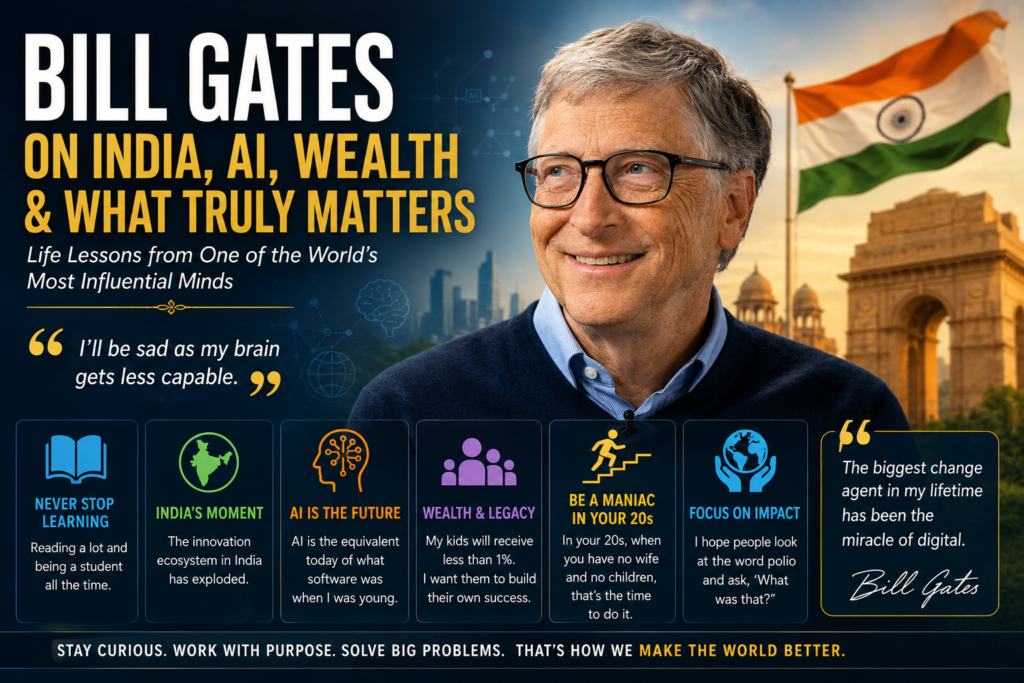
Bill Gates on India, AI, Wealth, and the Fear That Keeps Him Awake
There are interviews you watch and forget.
And then there are conversations that stay with you for years.
Sitting across from Bill Gates was one of those moments.
As a child, I had read about him in school textbooks and newspapers. He was the man who built Microsoft, became one of the richest people in the world, and later dedicated most of his fortune to solving humanity’s toughest problems.
Years later, that same child found himself asking Bill Gates questions about India, artificial intelligence, philanthropy, inheritance, and his biggest personal fear.
What followed was far more than an interview.
It was a masterclass on learning, purpose, and what truly matters in life.
Bill Gates on India: “The Innovation Ecosystem Has Exploded”
Bill Gates has visited India many times over the years, first through Microsoft and later through the Gates Foundation.
What stands out to him most is how dramatically the country has evolved.
“The level of entrepreneurship and innovation taking place in India is pretty fantastic.”
According to Gates, India is no longer just a large market.
It is becoming one of the world’s most important centers for:
- Artificial intelligence
- Healthcare innovation
- Vaccine development
- Agriculture technology
- Education technology
- Digital public infrastructure
In his words, what is being built in India will benefit not just the country, but the entire world.
Why India Is Producing Global CEOs
When asked why Indian leaders such as Satya Nadella and Sundar Pichai are leading some of the world’s biggest companies, Gates offered a simple explanation.
India combines:
- Exceptional engineering talent
- Strong educational institutions such as the Indian Institutes of Technology
- A massive population base
- Increasing global exposure
“When you get people who are both great at engineering and management, that’s a magic combination.”
Bill Gates’ Inheritance Philosophy: His Children Will Receive Less Than 1%
One of the most striking moments in the interview came when Gates explained how he plans to distribute his wealth.
Despite his enormous fortune, his children will receive less than 1% of it.
Why?
Because he believes excessive inheritance can limit rather than empower.
“I want to give them a chance to have their own earnings and success.”
Instead of building a family dynasty, Gates is directing the majority of his wealth toward solving problems such as:
- Polio
- Malaria
- Malnutrition
- Global health inequities
It’s a powerful reminder that true legacy is measured by impact, not accumulation.
If Bill Gates Were Starting Today, He Would Build in AI
When asked what industry he would enter if he were a young entrepreneur in India today, Gates didn’t hesitate.
Artificial intelligence.
“AI is the equivalent today of what software was when I was young.”
He believes AI offers unlimited possibilities and will create companies of extraordinary scale.
At the same time, he emphasized that success will be rare.
Only a few startups out of thousands will achieve transformational impact.
But the opportunity is real.
The Biggest Misunderstanding About Bill Gates
What do people get wrong about him?
Gates said many assume that wealthy individuals have hidden agendas or fundamentally different values.
“People think someone with ridiculous amounts of money must have some grand scheme.”
But those who know him personally see a very different picture.
A man deeply committed to:
- Learning
- Scientific progress
- Philanthropy
- Family
- Global health
Bill Gates’ Biggest Fear at Age 70
This was perhaps the most human answer of the entire conversation.
Gates said he isn’t afraid of heights, planes, or fire.
His greatest fear is losing his ability to learn.
“I’ll be sad as my brain gets less capable.”
For someone whose greatest joy is understanding new ideas, the possibility of cognitive decline is profoundly unsettling.
That answer reveals what has driven him all his life.
Curiosity.
One Habit Everyone Should Adopt
When asked to name one behavior that contributed most to his success, Gates gave an answer every student should remember.
“Reading a lot and being a student all the time.”
He credits lifelong learning as one of the biggest reasons for his achievements.
His approach is simple:
- Read extensively
- Ask difficult questions
- Challenge your assumptions
- Build knowledge continuously
In a world of endless distraction, this advice is more valuable than ever.
Bill Gates’ Advice for People in Their 20s
Gates described his twenties with one unforgettable word:
Maniac.
He worked obsessively, often staying in the office for days.
“If you’re in a race, your 20s—when you have no wife and no children—are the time to do it.”
This doesn’t mean everyone should work nonstop.
But if you are pursuing something meaningful, your twenties are a unique period to build extraordinary momentum.
How Bill Gates Predicts the Future
Many people view Gates as a visionary because he anticipated:
- The internet
- Digital money
- Video conferencing
- Global pandemics
- The rise of AI
His secret is surprisingly straightforward.
He spends time deeply understanding technologies that can change the world.
Then he studies how they intersect with humanity’s biggest challenges.
“The biggest change agent in my lifetime has been the miracle of digital.”
Bill Gates’ Five Biggest Global Concerns
Gates said the world must address several existential risks:
- Artificial intelligence alignment
- Future pandemics
- Nuclear war
- Bioterrorism
- Climate change
He believes humanity now has the tools, wealth, and scientific knowledge to reduce these threats—if we act responsibly.
India’s Role in Solving Global Problems
Gates sees India as central to global progress.
Areas where India is leading include:
- Affordable innovation
- Vaccine manufacturing
- AI for healthcare
- Digital identity systems like Aadhaar
- Digital payments infrastructure
He noted that many of these solutions are already being adapted for countries across Africa.
In other words, India is not just developing for itself.
It is building models the world can replicate.
What Bill Gates Wants to Be Remembered For
When asked what he hopes history will say about him, Gates didn’t mention wealth or software.
Instead, he spoke about eradicating disease.
“I hope people look at the word polio and ask, ‘What was that?'”
If future generations no longer worry about polio, malaria, and severe malnutrition, he believes that will be his most meaningful contribution.
Key Lessons from Bill Gates
Stay a Student Forever
The habit of learning compounds over decades.
Use Wealth Purposefully
Money becomes meaningful when it solves real problems.
Work Intensely When You Are Young
Your twenties offer a rare window to build something extraordinary.
Embrace AI
Artificial intelligence is one of the largest opportunities of our time.
Think Beyond Yourself
The most fulfilling ambitions improve life for others.
Final Thoughts
What struck me most about Bill Gates was not his intelligence or wealth.
It was his relentless curiosity.
At nearly 70 years old, he still approaches the world like a student.
Still reads hundreds of pages.
Still asks difficult questions.
Still believes humanity can solve its biggest challenges.
And perhaps that is the greatest lesson of all.
Success is not about having all the answers.
It is about never losing the desire to keep learning.