Why India Must Become a Product Nation: Insights from Dr. Ajay Chowdhry
From IT Services to Tech Sovereignty: Why India Needs Its Own Products
India today stands at a historic crossroads. While the country has emerged as a global leader in IT services and software exports, it remains dangerously dependent on imported hardware, chips, devices, and core technologies—most of them originating from China and the United States. This dependence is no longer just an economic issue; it has become a national security, employment, and sovereignty challenge.
In a wide-ranging conversation on the NI Podcast, journalist Smita Prakash spoke with Dr. Ajay Chowdhry, co-founder of HCL and often called the Father of Indian Hardware. What followed was a powerful, sometimes uncomfortable, but deeply necessary discussion on why India must urgently shift from being a services nation to a product nation.
The Hidden Risk in “Made in India”
Almost every electronic product we use today—phones, CCTV cameras, attendance machines, routers, drones—contains Chinese chips.
When the Indian government introduced biometric attendance machines across central government offices, an intelligence audit later revealed something alarming:
Data from these machines was being transmitted back to China.
The same concern applies to CCTV cameras installed across cities. Most contain Chinese components, making real-time surveillance data potentially accessible to foreign entities.
“Every street, every movement, every data point—if your hardware is foreign-controlled, your security is compromised.”
This is not paranoia. The US and Europe have already banned Chinese CCTV systems from government use. India, despite being a high-risk geopolitical zone, continues to import them at scale.
India Has No Indian Phone
India sells nearly 150 million smartphones every year.
About 60% are Chinese brands.
The rest are Apple and Samsung.
India does not have a single fully Indian smartphone.
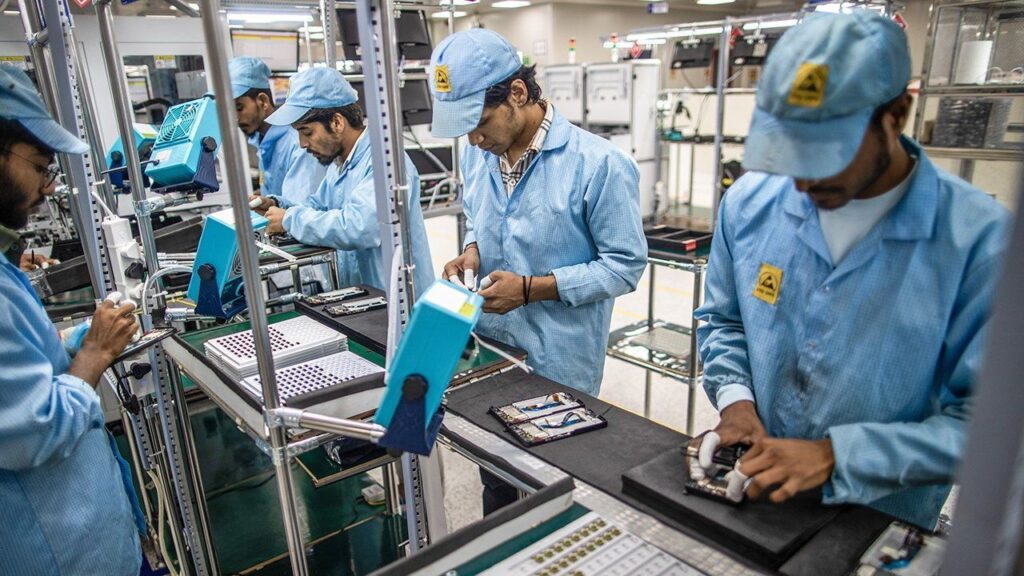
Even when phones are “manufactured in India,” most of the process is screwdriver assembly. The kits, chips, displays, and core electronics come from China.
“We assemble here, but the value addition is close to zero.”
This means:
- No control over data
- No intellectual property
- No long-term ecosystem
- No deep manufacturing jobs
How India Lost Its Hardware Industry
Dr. Chowdhry started HCL in 1976 as a hardware company that designed and built computers in India.
So what went wrong?
WTO Agreement Fallout
- India signed the WTO Information Technology Agreement
- It was implemented in 2005 without consulting the domestic electronics industry
- Import duties dropped to zero
- Indian hardware companies collapsed
- China and Brazil did not sign the same agreement—and surged ahead
“China protected its electronics industry. We destroyed ours.”
The Illusion of a Services-Led Economy
Today, nearly 60% of India’s economy depends on services.
This model is extremely fragile.
When global tech firms slow down or adopt automation and AI, mass layoffs follow—as seen globally in 2024–25.
“A services economy collapses when demand drops. A product economy survives.”
Why Products Matter
- Products create long-term jobs
- Manufacturing + maintenance = 5x employment
- Products generate IP, exports, and resilience
- Services alone cannot absorb India’s engineering talent
India Has Design Talent—But No Products
A common myth: India lacks hardware talent.
Reality:
- India is the second-largest chip design hub globally
- Companies like NVIDIA, Intel, AMD, MediaTek all design chips in India
- Thousands of Indian engineers design world-class silicon—for export only
“We design for the world, but not for ourselves.”
The Solution: System → Chip → Fab → Market
Dr. Chowdhry proposes a clear roadmap:
- Identify 20 critical systems India must own (telecom, power, defence, mobility, health, etc.)
- Break them into subsystems
- Design chips for those subsystems
- Manufacture and package in India
- Only then block imports step-by-step
“You don’t shut imports first. You shut them when your chip is ready.”
The ₹1 Lakh Crore R&D Opportunity
The Government of India has announced a ₹1 lakh crore Research & Development Fund, interest-free for 50 years.
This is historic.
For the first time:
- Government money will flow into private R&D
- Corporates and startups can co-invest
- Engineers laid off globally can be absorbed
- Indian diaspora can be brought back
“This fund can create products, not just papers.”
Startups Are Being Crippled by Policy
Despite innovation, Indian startups face structural barriers:
1. Bank Guarantees
- A startup receiving an ₹11 crore defence order may be asked for a ₹9 crore bank guarantee
- Impossible without equity dilution
2. Working Capital
- No dedicated startup credit policy
- Founders sell equity just to deliver orders
3. ESOP Taxation
- Employees taxed at vesting, not exit
- No cash to pay tax
- Discourages talent from joining startups
“We punish risk-takers and reward importers.”
Demand Aggregation: The China Playbook
China succeeded because:
- Government aggregated domestic demand
- Gave massive orders to local companies
- Provided export credit through state support
- Pushed products globally via embassies
India can do the same.
Example:
- BSNL gave a ₹13,000 crore 4G order to Tejas Networks
- Tejas became globally competitive overnight
“Why can’t Tejas and Tata become global giants?”
Rare Earths: The New Weapon
China controls 90% of global rare earth processing.
Rare earths are critical for:
- EVs
- Batteries
- Chips
- Defence electronics
Mining them is environmentally dangerous and slow.
The Faster Alternative: E-Waste
- India is the 2nd largest e-waste producer
- 30–40% of rare earth needs can be met by recycling e-waste
- Faster, cleaner, strategic
“Urban mining is our best chance.”
Data Is the New Oil—and We’re Giving It Away
With cloud, SaaS, and AI:
- Indian data sits on American servers
- Chinese hardware captures raw signals
- AI models are trained using Indian data
“They build AI using our data, then sell it back to us.”
From smart speakers to laptops, anything connected to the internet can transmit sensitive information.
Education Must Teach Product-Making
India produces millions of engineers—but few product builders.
Problems:
- No “make a product” requirement
- Excess theory, zero hands-on work
- No exposure to manufacturing, repair, or design
Solutions underway:
- AICTE introducing product-building programs
- Maker spaces in engineering colleges
- Industry-linked curricula
“Innovation happens with hands, not slides.”
Quantum, AI, and the Next Frontier
As Chairman of India’s National Quantum Mission, Dr. Chowdhry highlights:
- Quantum computing will redefine cybersecurity
- Quantum communication can make data unhackable
- Drug discovery timelines will collapse
- India must not depend on imports
“Sanctions created ISRO. Sanctions created atomic energy. Crisis forces innovation.”
Final Thought: Aspiration Changes Destiny
HCL started with ₹1.86 lakh and six people.
Today it is a $14 billion global company.
“If you have aspiration, resources will follow.”
India has:
- Talent
- Market
- Capital
- Strategic need
What it needs now is confidence, protection, and execution.
🇮🇳 The Choice Before India
Remain a digital colony,
or rise as a sovereign product nation.
The window is open—but not forever.